Inside the high-stakes realm of modern pro-level oversteer competition, victory is not merely solely a result of sheer horsepower or behind-the-wheel bravado. Rather, it is now a complex discipline which demands a meticulous marriage of choosing a time-tested car, arming it with the correct performance components, and, most critically, understanding its dynamic characteristics on the course through cutting-edge suspension tuning applications. This definitive handbook acts as your roadmap from the very first concept of a drift build all the way to the last engineering-refined tweaks that transform a powerful vehicle into a predictable winner. We will delve deep into the methodical process of chassis dynamics adjustment, illustrating how a modern suspension tuning tool like GripDial eradicates assumptions and provides unparalleled insight into your chassis's actual performance.
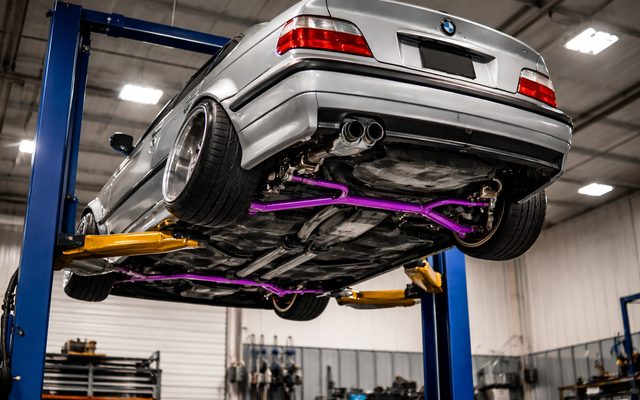
The foundation of any great competitive sliding vehicle is, undoubtedly, the base vehicle itself. A select group of platforms have earned legendary reputation within the global oversteer scene due to their inherent weight distribution, robust build quality, and the vast ecosystem of performance components available. Choosing the optimal platform is the primary and most crucial selection a builder will make. For instance, the BMW E36 is widely regarded as perhaps the the finest all-around drift platforms of all time. Its excellent balanced front-to-rear weight, alongside a rear-wheel-drive setup and robust inline-six powerplants, forms a chassis that is simultaneously easy to handle for beginners and highly competitive in the possession of a professional driver. The next step of this philosophy, the BMW E46, improves on these qualities with a increasingly refined frame, wider wheel track for greater stability, and even a greater degree of lock as standard from the OEM. Another powerful platform in the pro scene is the Chevrolet Corvette C6.
This American performance car introduces a distinctive array of benefits to the sideways sport, including a light alloy structure, a rear-mounted gearbox and differential unit that helps create an perfect front-to-rear mass ratio, and the colossal thrust of a large-displacement LS-series V8 engine. This combination makes it an complete force on track, designed of entering and sustaining continuous angles with seemingly effortless deployment of acceleration. For builders looking for exceptional value, the Nissan Z33 excels as a top-tier choice. It arrives from the manufacturer with a robust body structure, a effective factory limited-slip differential, and the responsive VQ series engine that provides plenty of performance for learning and moving up in the activity. Its newer version, the Nissan 370Z, brings additional refinements in body strength, suspension design, and outright powerplant power, cementing its status as a popular choice among professional drivers. Further iconic platforms that merit mention are the agile rotary-powered Mazda FC, the ubiquitous Nissan S13 240SX, the torque-rich Ford Mustang SN95, the modern BMW E90, and the small yet incredibly fun and teachable Mazda MX-5. Every single one of these platforms gives a distinct palette of traits, difficulties, and capabilities, but they all share the core components required to be transformed into a serious sliding vehicle.
However, choosing the correct car is merely the starting point. To unlock the complete potential of any of these machines, significant upgrades to the steering and chassis control systems are absolutely mandatory. This is where the world of performance tuning parts becomes sharp view. The most most game-changing upgrade for a serious competition vehicle is the installation of a maximum-angle angle modification kit. These sophisticated kits, like those engineered by performance brands like specialist manufacturers, are designed to radically increase the car's available turning lock. A OEM road car is highly constrained in how far its tires can turn, a design compromise for on-road use. In oversteer driving, however, extreme countersteering is constantly required to catch and maintain a angle. An modification kit exchanges the stock hubs, linkages, and often suspension arms with parts that enable the wheels to achieve angles over 70 or even 80 degrees, as opposed to a normal stock limit of around 40 to 50 degs.
This immensely increased steering angle offers the operator with dramatically more control during a angle, allowing it to be much easier to begin a drift, maintain it through a long bend, and switch smoothly from one side to the other. The difference in drivability is truly transformative. Coupled with a properly specified steering kit is the equally vital modification to the chassis's damping system. Off-the-shelf or including premium sport adjustable suspension are simply not intended for the unique and extreme demands of competitive oversteer. A purpose-built system of adjustable dampers is paramount. These specific coilovers incorporate specific valving and spring stiffness that are designed for the rapid mass transition that is inherent of aggressive driving. When a driver begins a drift, the car's inertia is thrown violently to the outside of the turn. Optimal drift-spec dampers handle this transfer in a consistent manner, allowing the car to settle quickly and giving the driver precise response through the steering wheel and driver's seat. They furthermore allow for precise tuning of stance, damping firmness, and cross-weight, which are all fundamental parts of fine-tuning the car's dynamics to a given track or piloting approach. As a system, a high-quality angle modification system and a properly chosen pair of drift-spec suspension units are the absolute physical base upon which all future refinement is based.
Once the core hardware is installed, the next critical phase in the build is the meticulous tuning of the vehicle's suspension geometry. This is the domain of vehicle alignment optimization, a methodology that can appear intimidating to the newcomer but is, in practice, the defining factor to transforming a set of capable pieces into a harmonious and controllable vehicle. The most critical element of tuning for oversteer is undoubtedly camber. Camber is the tilt of the tire in relation to the upright plane when observed from the front-on of the car. When the top edge of the tire is leaning towards the car, this is referred to as negative camber. In sliding, inward-leaning wheels on the front tires is widely employed and is regarded as essential. The logic is intrinsically linked to vehicle dynamics.
When a car is turning at extreme sideways angles, the chassis rolls to the outer of the turn. This lean makes the outside front wheel to reduce its optimal grip area with the track surface. By introducing inward lean, the tire is pre-tilted to account for this roll. As the chassis rolls into the bend, the outside front tire becomes more upright against the track, maximizing its bite at the exact point when it is needed most for steering authority. Usually, front axle adjustments for a competition drift car vary from approximately -3 degrees to as extreme as -5 degrees or even beyond, contingent on the specifics of the chassis configuration, compound choice, and operator preference. The rear axle wheels also employ inward lean, but the settings are usually more conservative and less aggressive than the front axle. Excessive inward lean at the back can cause the vehicle to extremely loose and challenging to predict on power use, as it shrinks the usable contact patch of the powered tires during linear acceleration. Therefore, rear axle adjustments are drift tuning app commonly in the ballpark of -1 degree to -3 degrees, striking a delicate compromise between offering adequate side bite to assist in entering and maintaining the angle while still maintaining good hook-up for exiting the bend. camber angle is just one element of the broader suspension geometry equation, which furthermore involves toe setting, caster, and bump steer correction.
Toe describes the direction of the wheels as seen from the top. Inward toe means the leading edges of the tires are nearer together than the trailing edges, while negative toe means the reverse. For oversteer, a small amount of front toe-out is frequently employed to sharpen the initial steering response, making the chassis feel more responsive and ready to begin a drift. Rear toe setting is typically set to zero or a incredibly minute amount of positive toe to encourage predictability under power. Caster is the forward or rearward inclination of the suspension pivot when viewed from the side of the chassis. More positive caster improves steering feel and high-speed solidity, and it additionally increases negative camber effect during turning, which is highly beneficial. Setting these parameters is a detailed dance where a change to a single value can and often will affect the other settings. The traditional method for dialing in a vehicle's suspension geometry for sliding has historically been a tedious affair of trial and error. A tuner or engineering group would introduce a adjustment based on experience, drive the vehicle on track, use the operator's individual feel and feedback, and then make a further change. This loop would repeat time after time until the chassis felt "acceptable" or the allotted track period was exhausted. This system is not just incredibly inefficient in terms of hours and tires, fuel, and parts, but it is additionally fundamentally imprecise.
Pilot perception is a notoriously inconsistent measurement tool, colored by many factors such as tiredness, changing track surfaces, temperature, and just the mindset of the driver on that particular run. What feels "tail-happy" on one lap might feel "tight" on the following pass, leading to contradictory information and ineffective adjustments. This long-standing challenge in chassis setup is precisely where modern technology has stepped in to revolutionize the process.
The advent and adoption of advanced suspension tuning applications has introduced a radically different paradigm for tuning and refining professional drift cars. This new generation of platforms, exemplified by groundbreaking systems like GripDial, function by actively recording the actual physical performance of the chassis as it is operated on the course. Unlike using subjective impression, these devices gather objective data on key variables such as damper compression and extension, corner velocities, acceleration forces, wheel angle, and throttle and brake input. This collected telemetry is then processed by advanced software that can graph and analyze the information in a comprehensible format. For the first time ever, drift telemetry software drivers and crews can see exactly what the vehicle is performing at any given millisecond of a lap. This capability transforms the whole suspension tuning procedure. Think about the aforementioned challenge of optimizing the front axle camber for a particular chassis. Instead of applying a modification from -3 degrees to -3.5 degrees and then running several passes to try and "feel" a difference, a suspension tuning tool can deliver immediate and definitive data. The software can display graphically how the suspension's loading is performing during the critical moments of a slide: initiation, holding the angle, and switch. It can reveal if the existing camber setting is permitting the loaded tire to maintain ideal grip or if the tire is over-stressed on its outside shoulder.
The tool can subsequently provide data-driven recommendations for adjustment. Perhaps the data reveals that the tire is still stressing its edge at -3.5 degrees of negative camber, suggesting that a move towards inward lean, say -4 degrees, might be warranted. Conversely, the information might indicate that the tread is not coming up to temperature or that the inside drift suspension tuning guide shoulder is degrading excessively, which could indicate that there is overly aggressive angle and a small lessening back to -3.2 degrees would be better efficient. This level of granularity and useful analysis was literally unimaginable in the time of solely seat-of-the-pants setup.
The benefit of utilizing a advanced drift telemetry system extends well beyond only optimizing camber angles. It functions as an invaluable damper adjustment manual that is specific to your exact vehicle. When fine-tuning the shock absorber clickers on your coilovers, instead of using vague advice or copying another team's settings, you can use the software to observe how the car is performing in response to your adjustments. The software can graph the wheel movement trace over a run, highlighting if the coilovers are controlling the weight transfer properly or if they are permitting the chassis to oscillate too much after a direction change. It can aid in pinpointing challenges like bottoming out or topping out, enabling you to introduce data-backed adjustments to helper springs, rebound/compression values, or ride height. This process extends similarly to the complex task of suspension geometry optimization. In addition to camber angle, the software can provide insight into how adjustments to toe settings and caster are influencing the vehicle's balance during various parts of a drift. For example, it can assist you to find the ideal amount of front toe out for your individual steering geometry and competition approach by measuring the speed of initial reaction and the predictability of the chassis at lock steering angle. This turns the tool an exceptionally effective drift suspension tuning guide that is constantly informed by the real-world behavior of your own car on the circuit. It moves the complete process from a subjective skill into a repeatable development exercise.
Additionally, the utility of a tool like modern telemetry is in no way restricted to professional teams with extensive budgets. For the amateur competitor, it serves as an powerful equalizer. It effectively provides the driver with the analysis of a professional suspension specialist without the corresponding overhead. It speeds up the tuning process by providing unambiguous directions to questions that would normally take seasons of experimentation to understand. A tuner can see how their particular chassis behaves to different adjustments, gaining a deeper comprehension of suspension theory in the journey. It also makes accessible professional chassis dynamics techniques, allowing every enthusiast with the desire to optimize their car to achieve it in a efficient and productive fashion. This is notably valuable in a sport like sliding, where tuning expertise has traditionally been a tightly held asset among top teams. In the modern era, that knowledge can be in the hands of any dedicated driver.
In summary, the path to engineering and dialing in the perfect championship-contending sliding vehicle is a multi-faceted mission that smoothly integrates time-honored engineering principles with revolutionary data tools. It begins with the wise pick of a capable car, followed by the installation of essential drift-spec parts like drift-spec drift angle kits and correctly valved performance suspension units. The build then moves into the precision phase of alignment optimization, where parameters like negative camber, toe setting, and caster angle are carefully configured to match the car's new hardware and the driver's individual style. The final step, and what really separates the modern process from the old ways, is the adoption of a powerful vehicle dynamics tool. This platform removes the guesswork and trial and error of only feel-based setup by providing quantifiable, real-time information on how the car is actually functioning. It acts as an indispensable suspension tuning tool, a definitive coilover setup manual, and a comprehensive vehicle dynamics tool. In unison, this integrated methodology guarantees that every component of the drift car—from the selection of the platform to the final adjustment on the suspension—is perfected for maximum performance on the circuit. It signifies the total evolution of the discipline of oversteer driving, bridging raw car control with data-informed chassis dynamics to build the perfect dominant machines imaginable.